Denial Overturn Rates by Payer and Appeal Level
More than half of denied claims get overturned on appeal.
Denial rates across payer types: public, private, and the managed-care middle ground
The industry-wide initial denial rate hit 11.8% in 2024, but that single number hides more than it shows. Medicare Advantage plans deny at 15.7%, traditional Medicare denies at 9.1%, and more than half of all denials get paid once someone actually challenges them. Providers who fight every denial and providers who write off every denial are both wrong, just in opposite directions. Where the odds favor pushing hard and where they don't varies by payer.
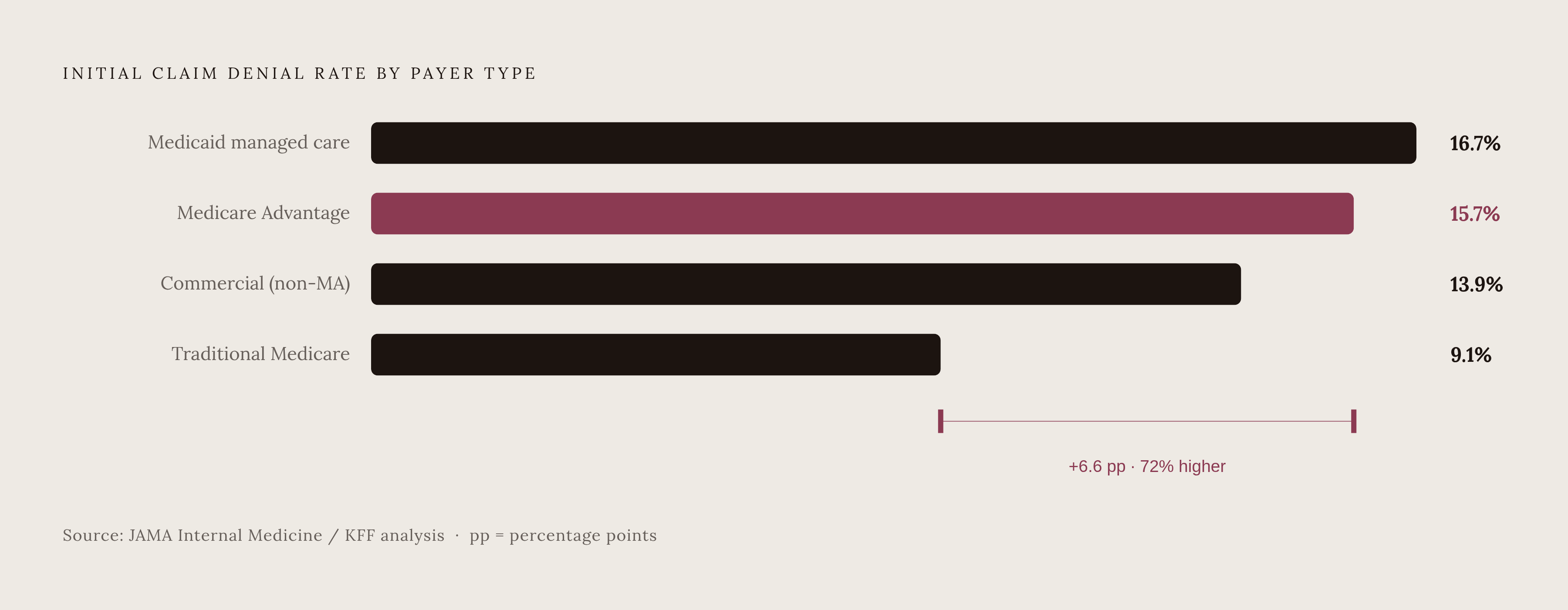
A healthcare data and advisory firm's survey of 516 hospitals lays out the clearest picture. Medicaid managed care denies the most, at 16.7%. Medicare Advantage follows at 15.7%, commercial payers outside Medicare Advantage are 13.9%, and traditional Medicare, run straight by the federal government with no managed-care layer in the middle, denies at just 9.1%.
That gap isn't random, and it isn't small either. Medicare Advantage denies at a rate 56% higher than traditional Medicare, and the reason traces back to prior authorization, medical necessity review, and clinical editing software, the utilization management machinery traditional Medicare simply doesn't run with the same force. Traditional Medicare pays a claim once it clears coverage criteria on its face. Medicare Advantage, sold by private insurers under contract with CMS, stacks review steps on top of that baseline, and every added step is another chance to say no.
Prior authorization sits at the center of the entire system. KFF reports insurers made close to 53 million prior authorization determinations for Medicare Advantage enrollees in 2024 alone, an entire industry function built around pre-screening care before a patient ever gets it. CMS-0057-F data covering roughly 71 million people across 14 insurers for CY2025 shows Medicare Advantage denying 12% of standard prior auth requests, Medicaid managed care denying 14%, and ACA marketplace plans denying 18%, the highest of the three. The marketplace, oddly enough, is where the extra layer of review cuts deepest.
Named-payer denial rates in the ACA marketplace, the wide spread between worst and best
Moving from program averages to individual insurers, the range turns uncomfortable fast. MoneyGeek's analysis of the CMS Transparency in Coverage 2026 Public Use File puts Oscar Health at a 25.3% denial rate, the highest among major national insurers and an eight-point jump from 2023. Molina Healthcare is 22%, up about three points year-over-year. UnitedHealthcare processed 6.4 million claims in this dataset, the largest volume of any single insurer tracked, and denied 19.1% of them in 2024, down sharply from 34.2% the year before. A swing that size doesn't happen by accident; it looks like a deliberate policy shift.
Older 2023 figures from a TechTarget analysis round out insurers the newer file hasn't caught up to: Sendero Health Plans at 28%, Community First Health Plans at 26%, Anthem at 23%, Aetna at 22%.
The other end of the spectrum tells the opposite story. Avera Health Plans denies just 1% of claims. PacificSource Health Plans is 2%, Providence Health Plan is 4%, Sanford Health Plan is 5%, and Kaiser Permanente is around 6% among major national insurers. Same ACA marketplace rules, same regulators, same product on paper, and a 25-point spread in how often coverage gets refused. That spread is the whole case against treating "the insurer denied it" as one piece of information. It tells a provider almost nothing until they know which insurer said it, and acting like all denials carry equal weight is how revenue gets left on the table.
The appeal participation gap, most denied claims are never challenged
Almost nobody appeals. HealthCare.gov logged roughly 85 million in-network denied claims in 2024, and consumers filed at least 262,982 appeals against that pile, fewer than 1% of the total. Providers do better, but nowhere near well enough: Industry data shows roughly 35% of denied claims get appealed by providers. 65% simply get written off or never resubmitted.
Research on why patients skip the fight points to a consistent pattern: they don't know their rights, they doubt an appeal would go anywhere, and plenty don't even know who to call to start the process. Providers face a different wall: cost. The cost of pursuing a single appeal is not trivial, and that reality is why triage has to happen before the appeal gets filed, not after. Not every denial deserves the same fight. Appealing everything burns money on weak cases, and appealing nothing hands revenue back to the payer for free.
Internal (first-level) appeal overturn rates, where more than half of fights are won
Available data indicates that a majority of denied claims get overturned and paid on internal appeal, which is the single strongest argument in this entire dataset for appealing more, not less. That beats a coin flip across the whole denial population, before anyone even sorts out which claims make the strongest candidates.
Break it down by payer type and the pattern holds, with some spread between the payer types. Private commercial payers overturned more than half of initial denials, and related industry data suggests private payer overturns run at a similarly strong rate. Medicare Advantage overturned a substantial share of denials on internal appeal. Medicare and Medicaid combined trended lower than commercial payers, with Medicaid the weakest performer among the program types.
The ACA marketplace tells a similar story from a different angle: insurers upheld 66% of internal appeal decisions, meaning close to a third of marketplace internal appeals flipped the original denial. Prior authorization appeals post the strongest numbers anywhere in this dataset. A substantial majority of Medicare Advantage prior authorization appeals ended in the insurer partially or fully reversing its own initial call, and that pattern held steady across multiple years, not a one-year blip. That consistency is widely read as evidence that a large share of initial denials were never justified. Provider-initiated appeals do even better than patient-initiated ones: gomedicalbilling data puts them at roughly 70% overturned.
External review overturn rates, a meaningful second chance with different odds by payer type
Once internal appeal runs out, external review is the next stop, handled by an independent agency sitting outside the insurer's own chain of command. Available data puts the external review overturn rate at roughly 40% to 50%, close to a coin flip and a real one, shifting by state and by the type of denial involved.
Almost nobody takes that second shot, even after sitting through an entire internal appeal already. Marketplace enrollees filed at least 5,881 external appeals in 2024, just 4% of all upheld internal appeals. The vast majority of denials that survived round one got dropped rather than escalated, despite odds that favor the challenger close to half the time.
New York's longitudinal tracking shows those odds improving over time. The share of denials overturned on external appeal rose from 38% in 2019 to a higher share in more recent years, over that same stretch. Break it out by service type and home healthcare stands apart: home healthcare denials were overturned at a notably high rate in New York's data. Prescription drugs and dental procedures ran lower but still favorable, above 50%.
Named-insurer overturn rates for Medicare Advantage prior authorization appeals
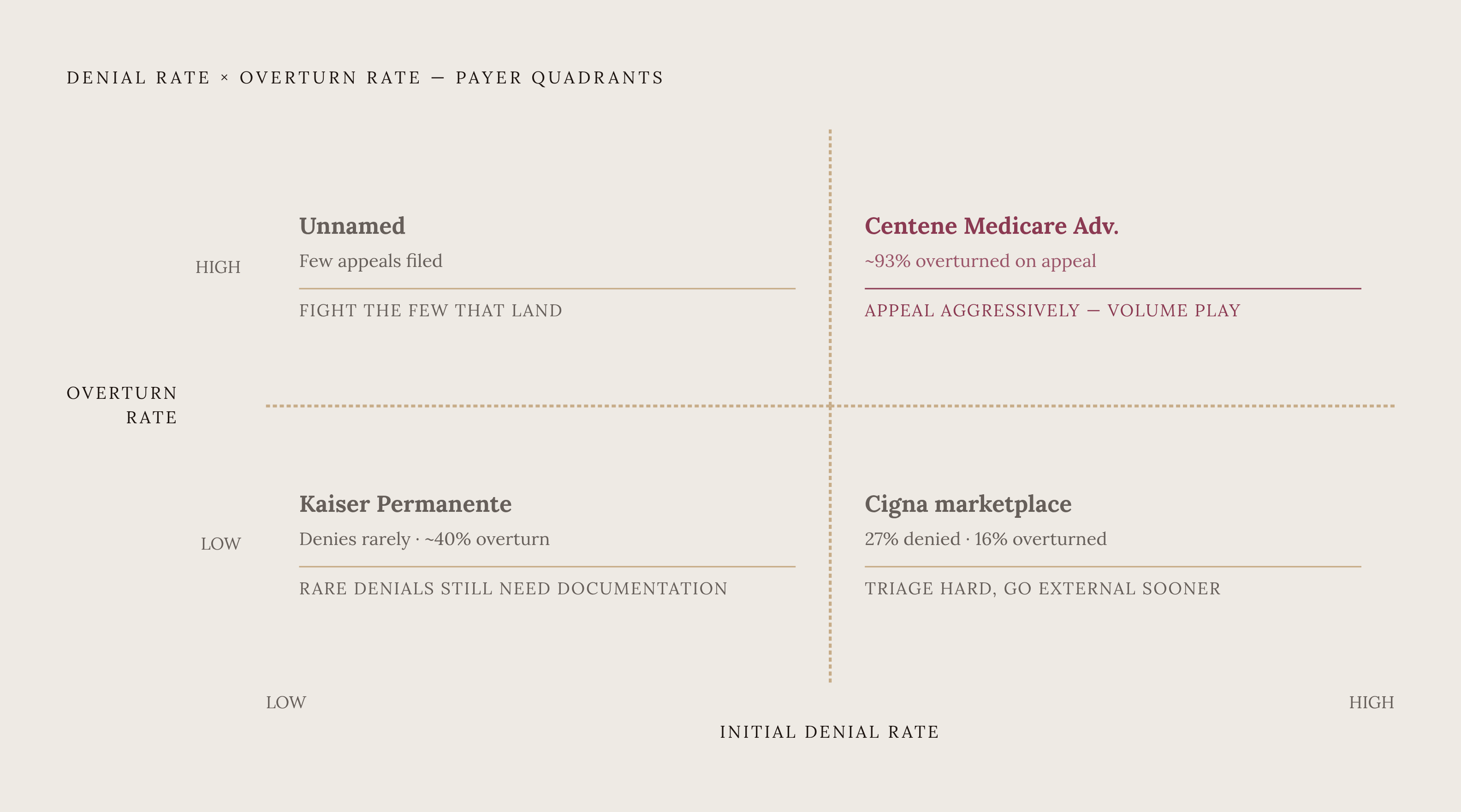
KFF's analysis of the same CMS-0057-F data, reported in detail by HME Business, breaks the Medicare Advantage overturn rate down insurer by insurer, and this is where the spread gets widest in the entire dataset. Centene overturns roughly 93% of its own denied prior authorization requests once a provider appeals, the highest figure in the group. CVS, through Aetna, sits close behind at roughly 89%. Elevance runs roughly 75%, Humana roughly 64%, UnitedHealth Group roughly 60%. Kaiser Permanente posts the lowest overturn rate among the named major Medicare Advantage insurers, at roughly 40%.
Cigna's marketplace prior authorization numbers, also from CMS-0057-F, describe a much harder wall. Cigna denies roughly 27% of prior auth requests, and only 16% of those denials get overturned on appeal. A provider dealing with a Cigna marketplace denial should walk in expecting a real fight; a Centene denial tends to produce a near-automatic reversal.
A plan that reverses 89% to 93% of its own denials the moment someone appeals wasn't making defensible decisions the first time around, and that conclusion isn't up for debate. A national physicians' membership group and a national hospital trade group have both made that point directly, and the numbers back them up: an insurer getting the initial review right would not need to flip itself nine times out of ten.
Reading these rates together to build a payer-specific appeals strategy
Lining up the two numbers, initial denial rate and overturn rate, payers sort into four groups. High denial paired with high overturn, Centene's Medicare Advantage book is the clearest example, means the plan over-denies as a matter of routine and reverses itself constantly once pushed. Treat that as a volume play. Appeal aggressively, because the odds favor the provider almost every time.
High denial paired with low overturn is the harder combination, and Cigna's marketplace prior authorization numbers (27% denied, only 16% overturned) fall squarely inside it. That pairing calls for real triage: save the effort for claims with the strongest documentation, and move to external review sooner rather than burning time on an internal process that rarely bends.
Low denial paired with high overturn means fewer total appeals to file, but the few that do get filed are still worth the fight. Low denial paired with low overturn, Kaiser Permanente's pattern across both the marketplace and Medicare Advantage data, means denials are rare to begin with, though a rare denial doesn't reverse itself automatically just because it's rare. It still demands the same careful documentation as a harder payer, just less often.
Sequence matters as much as payer profile does. Internal appeal comes first, since that's where the largest share of reversals happens and the process moves fastest. External review comes second, and the 40% to 50% overturn rate there is too strong to leave sitting unused, especially given how rarely anyone actually files for it.
Kodiak's claims data shows inpatient commercial claims get denied initially at a 21% rate, but the final denial rate, after appeals run their full course, drops to just 3%. That 18-point gap gets recovered almost entirely through the appeals process itself, nowhere else. Skipping the appeal on an inpatient denial means walking away from close to the largest single pool of recoverable revenue in this entire dataset.
Prior authorization denials deserve the last word here. The AMA's finding that more than 80% of Medicare Advantage prior auth appeals succeed lands as close to the central fact of everything above: an initial denial in this category functions, more often than not, as an opening position rather than a final answer. Providers who stop at that opening position are the ones leaving money on the table.
Sources
- Breaking down claim denial rates by healthcare payer | TechTarget
- Insurance denial rates increased in 2025
- Payer Denial Tactics — How to Confront a $20 Billion Problem | AHA
- Claims Denials and Appeals in ACA Marketplace Plans in 2024 | KFF
- Which Insurer Denies the Most Claims? (2026 Data)
- Medical Billing Denial Statistics 2026: Industry Data & Benchmarks
- medicaldaily.com
- kff.org